
Facilities managers carry one of the most consequential sets of responsibilities in any organization. They are charged with keeping buildings operational, keeping people safe, and keeping the business out of regulatory trouble — often all at the same time. As industrial environments grow more complex and compliance requirements more demanding, the stakes attached to every decision about fire protection, chemical handling, physical security, and equipment maintenance continue to rise. The following guide covers the core knowledge areas every facilities manager should have a firm grip on, from suppression systems and corrosion control to environmental monitoring and on-site fabrication safety.
Understanding the Scope of Facilities Safety Responsibilities

The role of the facilities manager has changed dramatically over the past two decades. What was once largely a maintenance and logistics function has grown into a discipline that intersects with environmental compliance, occupational health, cybersecurity, and emergency preparedness. Today’s facilities managers are expected to understand not just what needs to be fixed, but why it failed, what regulatory framework applies, and how to prevent recurrence.
That scope demands a cross-functional mindset. Safety culture cannot live in a single department. It has to be woven into operations, procurement, HR, and executive leadership. Facilities managers who are most effective at building durable safety programs tend to be strong communicators who can translate technical risk into business language and earn buy-in across the organization.
Balancing compliance with operational continuity is another defining challenge. Facilities cannot simply shut down every time an inspection is due or a system needs upgrading. Effective managers develop schedules, redundancies, and vendor relationships that let them maintain safety standards without disrupting the work happening inside the building.
Conducting a Comprehensive Risk Assessment
Before any safety program can be built, the hazards that the program needs to address must be clearly identified. A comprehensive risk assessment looks at fire risks, chemical exposure risks, structural vulnerabilities, and the physical threats posed by unauthorized access or theft. It also considers the specific nature of the facility — a manufacturing floor presents a very different risk profile than a data center or a warehouse.
Once hazards are identified, they need to be prioritized. Not every risk is equally likely or equally catastrophic. The most effective risk frameworks evaluate threats based on both probability and impact, which allows managers to direct resources toward the issues most likely to cause serious harm or liability.
The output of a good risk assessment is not just a list of problems. It is a prioritized roadmap that includes timelines, responsible parties, and measurable outcomes. That document becomes the foundation for everything else in the safety program and should be revisited at regular intervals as the facility, its equipment, and the regulatory environment change.
Fire Suppression Systems and Prevention Planning
Fire protection is one of the most technically complex areas of facilities management, and it is also one of the most consequential. A suppression system that underperforms in an emergency is not just a regulatory failure — it can be a catastrophe. Getting this right requires understanding both the types of suppression technologies available and the specific conditions of your facility.
Wet pipe systems, dry pipe systems, pre-action systems, and gaseous suppression agents each have appropriate use cases. The right choice depends on the occupancy type, the materials stored or processed on-site, the ambient temperature range, and the nature of any sensitive equipment that might be damaged by water. Working with a licensed fire protection engineer on fire sprinkler design ensures that the system layout, pipe sizing, flow rates, and head placement all meet both NFPA standards and local code requirements. This is not a process to shortcut. A fire sprinkler design that looks adequate on paper but fails to account for actual heat release rates or obstruction patterns can leave portions of a building unprotected.
Once a system is installed, ongoing inspection and testing are mandatory. Most jurisdictions require quarterly, semi-annual, and annual testing intervals depending on the system type. Facilities managers should maintain detailed records of all test results, any deficiencies found, and the corrective actions taken. These records are critical during insurance audits, local inspections, and any post-incident investigations.
Managing Hazardous Materials and Chemical Safety
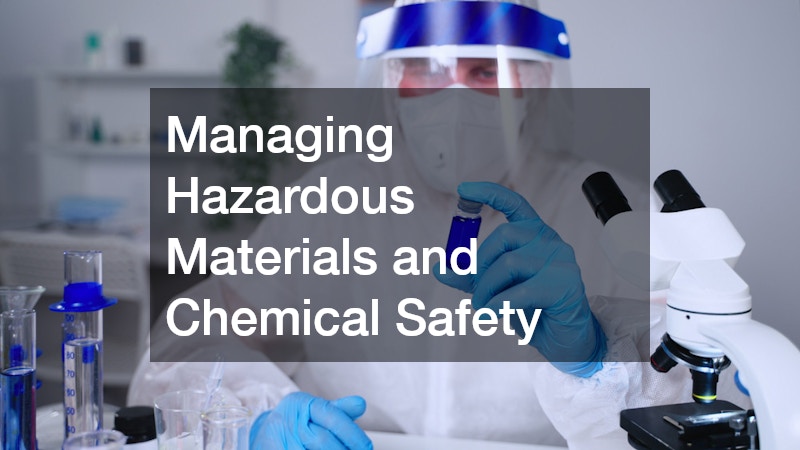
Facilities that handle flammable liquids, reactive compounds, oxidizers, or other hazardous substances face a distinct set of storage, handling, and disposal obligations. The starting point is understanding exactly what is on-site. A thorough chemical inventory — updated whenever products are added or removed — is the foundation of any hazardous materials program.
Storage protocols must account for chemical compatibility. Substances that react dangerously with each other must be physically separated, and storage areas must meet the ventilation, containment, and labeling requirements spelled out in OSHA’s Hazard Communication Standard and any applicable EPA regulations. Partnering with reliable specialty chemical suppliers is an important part of getting this right. Reputable suppliers provide current Safety Data Sheets, offer proper packaging and labeling, and can advise on storage and disposal requirements for the products they sell. Cutting corners by sourcing from unknown or non-compliant vendors introduces risk at every step of the supply chain.
Training is the other critical element. Workers who handle hazardous materials need to know how to read SDS sheets, what PPE is appropriate for each substance they work with, and what to do if there is a spill, a leak, or an exposure incident. Training should be documented, refreshed regularly, and verified — not just assumed.
Protecting Fuel Storage Infrastructure
Fuel storage represents a significant fire, environmental, and regulatory risk for facilities that maintain on-site reserves of diesel, gasoline, or other petroleum products. Both above-ground and underground fuel tanks are subject to detailed regulatory frameworks at the federal, state, and sometimes local levels, and compliance requirements have tightened considerably in recent years.
Facilities managers responsible for fuel tanks need to understand the inspection cycles, leak detection requirements, and spill containment standards that apply to their specific installation. Underground storage tanks, in particular, are subject to EPA regulations that govern everything from installation materials to release detection methods to closure procedures when a tank is taken out of service. Above-ground tanks have their own set of SPCC (Spill Prevention, Control, and Countermeasure) requirements that apply once storage capacity crosses certain thresholds.
Beyond regulatory compliance, proactive maintenance of fuel storage infrastructure makes good financial sense. Corrosion, seal degradation, and fitting failures are common failure modes, and catching them early through regular inspection and testing is far less expensive than remediating a fuel release.
Corrosion Control and Materials Durability
Corrosion is one of the most financially damaging and underappreciated threats in industrial and commercial facilities. It attacks piping systems, structural supports, storage vessels, and mechanical equipment slowly and silently, often remaining invisible until significant damage has already occurred. The American Society of Civil Engineers has estimated that corrosion costs the U.S. economy hundreds of billions of dollars annually — a figure that reflects how pervasive and expensive the problem is.
Effective corrosion management starts with material selection. Specifying the right alloys, coatings, and linings for the operating environment — whether that involves high humidity, chemical exposure, salt air, or elevated temperatures — can dramatically extend asset service life. Protective coatings must be applied correctly and inspected regularly, because even a well-chosen coating that develops pinholes or adhesion failures becomes a liability.
When corrosion issues arise that are beyond the scope of in-house capabilities, working with a qualified corrosion testing company can provide the technical depth needed to identify root causes and evaluate remediation options. These firms use test chambers and controlled exposure environments to simulate real-world conditions and evaluate how materials perform under specific stressors. Engaging a corrosion testing company is particularly valuable when specifying new materials for a challenging environment, when investigating premature failures, or when developing a maintenance standard for aging infrastructure.
Securing the Physical Plant Against Unauthorized Access
Physical security is sometimes treated as an afterthought in facilities management, but the consequences of inadequate access control can be severe — theft of equipment or materials, vandalism, workplace violence, and unauthorized access to hazardous areas or sensitive systems. A layered security approach addresses these risks more effectively than any single measure.
Perimeter security, access control at building entry points, and interior access restrictions for sensitive areas all work together to limit exposure. Electronic access control systems — key fobs, card readers, biometric scanners — allow managers to control who can enter which spaces, at what times, and to generate logs of access events that can be reviewed after incidents. Proper security system installation is essential to getting the full value from these technologies. Systems that are poorly installed, misconfigured, or not integrated with one another create gaps that undermine the entire security posture.
Video surveillance is a critical complement to access control. Surveillance cameras deter unauthorized activity, support investigations when incidents occur, and provide real-time monitoring capability when integrated with a security operations center. Camera placement should be designed to eliminate blind spots at entry points, loading docks, parking areas, and other high-risk locations. The video management system should be sized to retain footage for a period that meets both internal policy and any applicable regulatory requirements.
Environmental and Air Quality Monitoring
Air quality in industrial facilities can be compromised by a wide range of hazards — combustible gases, toxic vapors, oxygen-deficient atmospheres, and airborne particulates, among them. The consequences of inadequate monitoring range from regulatory citations to serious injury or death, which makes continuous detection one of the most critical investments a facilities manager can make.
A properly designed chemical monitoring system provides real-time data on the concentrations of targeted substances in the facility’s air. Fixed-point detectors placed at locations where leaks are most likely to occur form the backbone of most industrial monitoring programs, supplemented by portable meters for work in confined spaces or areas not covered by fixed sensors. The system should be calibrated regularly, tested against known concentrations to verify accuracy, and integrated with the facility’s emergency action plan so that alarms trigger a defined response.
Connecting monitoring data to regulatory reporting systems is increasingly expected by agencies like OSHA and the EPA, particularly in facilities that handle reportable quantities of hazardous substances. Facilities managers should work with their EHS team and legal counsel to understand which reporting obligations apply and to ensure that the monitoring infrastructure produces data in the format and at the frequency those obligations require.
Safe Practices for Maintenance and Fabrication Work
Maintenance and fabrication activities introduce some of the most concentrated fire and safety risks found in any industrial facility. Hot work — welding, cutting, grinding, and torch work — generates sparks and heat that can ignite surrounding materials, and it must be managed through a formal permit system that accounts for the specific conditions of each job.
A well-designed hot work permit program requires a pre-job hazard assessment, removal or protection of combustible materials within the work area, standby fire watch during and after the work, and inspection of the area before the permit is closed. Workers performing hot work also need access to proper welding supplies — appropriate electrodes, shielding gas, protective equipment, and ventilation — matched to the specific process and materials involved. Compromising on equipment quality or availability increases both safety risk and rework.
Pipe work is another common maintenance activity that requires proper tools and trained operators. Using quality pipe threading equipment, such as rigid pipe threaders, ensures that threaded connections are cut to the correct pitch and profile, which directly affects the integrity of the joint and the risk of leaks in process or fire suppression piping. As with all maintenance tooling, rigid pipe threaders and similar equipment should be inspected before use, maintained per manufacturer specifications, and operated only by workers who have been trained on the specific model in use.
Sourcing materials and equipment from reliable industrial suppliers is a quality and safety issue, not just a procurement preference. Substandard consumables — whether welding wire, pipe fittings, or chemical-resistant hose — introduce failure modes that can be difficult to diagnose and expensive to correct.
Building a Long-Term Safety Management Program
Individual safety measures — a good suppression system, a reliable monitoring network, a thorough access control installation — only deliver their full value when they are part of a coherent, managed program. Facilities managers who build durable safety programs treat safety not as a checklist but as a continuous improvement process.
That means establishing measurable performance indicators: incident rates, inspection compliance percentages, training completion rates, and time-to-close on identified deficiencies. It means reviewing those indicators regularly, identifying trends, and adjusting priorities and resources accordingly. And it means building relationships with vendors, inspectors, engineers, and regulators who can serve as informed partners rather than adversaries.
Technology continues to reshape what is possible in facilities safety management. From AI-assisted video analytics to cloud-connected sensor networks to building information modeling, the tools available to facilities managers are more powerful than ever. Leveraging those tools thoughtfully, with strong vendor partnerships and a clear understanding of what problems they are actually solving, is how modern facilities teams stay ahead of risk rather than perpetually catching up to it.